Healthy Food for Dogs: Homemade Recipes Click Here!
World Renown Animal Behaviorist And
Radio Talk Show Host, Dr. Dennis Fetko, Dr. Dog Reveals His
Proven Dog Training Methods. Stop Barking, Fighting, Biting,
Chewing, Digging, Soiling, Jumping, Pulling And More--with
No Jerking, Clicking, Or Squirting! Click Here!
How to
housebreak your puppy in 7 days or even
less. If you
need to potty train your puppy NOW - this
best selling system will show you how! Click Here!
How to
Get rid of Fleas
in your house and on your dog or
puppy. Kill Fleas
How to get Rid of Fleas
Getting rid of fleas on your dog
or cat alone does not treat
the overall flea problem.
During the flea cycle only about 5% of fleas are
actually living on your dog or cat. The other 95% of fleas are living in
your house or yard.
That is why it is so important to get rid of the fleas
in your house and on your dog or cat at the same time.
For example: You wash your dog in a flea rinse today
and you kill 20 fleas that are living on your dog. That means that there are
still approximately
380 fleas in the egg, larvae and pupae stage, developing in your house
waiting to hop back on your dog. (See the flea cycle chart at the bottom
of this page)
How do I get rid
of fleas?-
Treating the Flea Problem
Set aside a
couple of hours to tackle the
problem as it's not a five minute quick fix job. You will be treating your
pet and your pet's environment for fleas.
It is important to treat all of your pets
and your home on the same day. It is pointless to treat your house and not
your pets, and it is also pointless to treat you pet and not your house as
each one will re-infest the other if not treated simultaneously.
What you need to get started to get rid
of fleas
Your vacuum cleaner is a very
important tool in gaining control over fleas
You need to vacuum up all stages of the flea's
development. Eggs, Larvae and Pupae
Step 1 - How
to Get rid of the fleas in the house?
The first step is to
vacuum. As previously mentioned only 5% of the fleas are living on
your pet and that the other 95% are living in your house or yard. If you
have dogs that live inside or regularly come inside the house you need to
get rid of the vast majority of the fleas quickly and easily. You can
achieve this by vacuuming them up.
Vacuuming is one of the most important steps
of getting rid of fleas.
Listed below is what you are vacuuming up
Flea EGGS
Fleas
that are living on your dog lay eggs.
The eggs drop off your pet and land on your carpet or floor.
Flea LARVAE
The
eggs hatch and become larvae.
These little worm like creatures have hair structures which act like legs
and enable them
to move around.
Flea PUPAE
After a
while the larvae pupate. This means that they spin a cocoon around
themselves and begin a change. In the cocoon they are changing into
adult fleas. It is similar to a caterpillar which spins a cocoon and then
emerges as a butterfly. However it is an adult flea that will emerge from
this cocoon.
*Important Fact*
While the flea is in the pupal stage
(above) it is impervious to insecticides. The cocoon is waterproof and no
insecticides can get in to kill the developing flea. This is the reason
you must vacuum up as many of these pupae as possible. The vibrations from
vacuuming also stimulates the fleas to emerge from their cocoons and they
will be exposed to the insecticide that will be used.
Where to Vacuum for fleas
Flea eggs fall randomly wherever your
dog or cat goes, but once the eggs hatch they become larvae and have hair
like bristles on the outside of their body that enable them to move around.
This allows them to move to places they feel most comfortable in. They
like to get out of the light and into crevices, so when you vacuum pay
lots of attention to places such as near base boards (also known as
skirting boards), cracks in
floorboards and under furniture, beds and rugs.
Step 2 -
Spraying Insecticide for fleas
After vacuuming you will need to spray
an insecticide.
Flea
Treatment For
your House & Yard The products at right are for
illustration purposes only. Any spray which contains IGR is
suitable.
You will need to
purchase a flea spray containing IGR. Check the label for this ingredient.
IGR is the most important part of this flea
control procedure.
Precor
2000 Plus
House & Carpet Spray
Flea Fogger
Flea Bomb
House & Yard Spray
It is difficult to suggest flea control products worldwide as
insecticide laws vary from country to country. Below are a few
suggestions of products that contain IGR.
Precor 2000 Plus (US & Canada)
Hartz 4 in 1 Flea Fogger (US & Canada)
IG Regulator (US & Canada) Buy online or on ebay or check your pet store for availability.
Mortein Flea Bomb (Australia) Can be bought in most supermarkets.
Precor 2000 Plus is a hand held flea fogger. It has both a knockdown
agent and a long lasting insect growth regulator. The fog can be
directed under furniture and appliances.
What is IGR?
IGR is short for Insect Growth Regulator. IGR acts as Birth
Control for Fleas. It is a protein that works on the developing flea eggs and
larvae and stops fleas from developing to maturity so they cannot
reproduce.
Now it is time to spray the insecticide for fleas
Check the label for for active ingredients.
You must use one that contains IGR
if you want to totally eradicate all fleas from the house
Where to Spray for fleas?
Spray all floors, carpets, rugs
and places your pet sleeps. Pay particular attention to dark places such
as under furniture and beds. Spray all nooks and crannies and
especially around the baseboards (skirting boards) of the room.
Most people will find insecticides in aerosol form easier to apply than
liquids unless you have a pressure sprayer.
Don't forget to remove or cover any fish or reptiles that are in the
house. Flea sprays can kill them. It is recommended that you remove any
living creature from the house while spraying.
After spraying the insecticide try not to vacuum for about a week if
possible as the IGR component will have a residual effect.
Don't Forget about
your Yard and Garden
Do
fleas live in the yard?
Yesfleas can live outside the
house in sand and gravel. Spray
patios, under decks, verandahs, kennels, crevices, along fence lines and
anywhere your dog sleeps. It is not usually necessary to spray the entire
yard or areas which are exposed to sunlight as the larvae avoid bright places.
The flea spray you use in your house is fine to use in the yard too.
Next wash all of your pets bedding and soft
toys. Shake them well and hang them in the sunlight to dry.
STEP 3 - To get rid of fleas
Treat your dog or cat with a Flea
Product. Tablets
or
Top Spots
The older generation of flea control
products (Flea powders, flea collars and dips) are now completely
obsolete. The latest treatments are chewable tablets and top-spots, which are much safer for
both pets and humans.
Chewable Tablets to prevent fleas on
your dog
Comfortis Chewable Tablets for
Dogs are a meat flavored tablet that rapidly kills fleas on dogs
and then goes on to prevent flea infestations for a further
month. Comfortis starts to kill fleas within 30 minutes of
administration and will kill 100% of fleas on a dog within 4
hours. The tablets are FDA approved.
Give monthly with food. Comfortis may be a
little expensive but works 100%. Well worth the extra cost.
Top Spots are applied to the skin, usually between the
shoulder blades and disperse through the dog's coat. Usually applied
monthly they include Advantage, Frontline and Revolution. Most top-spot
flea treatments can be used on puppies from 8 weeks of age.
Advantage is applied to your pet and it spreads on the surface of the
skin at the hair root level, aided by body movement, to provide whole
body coverage. The revolutionary chemistry causes the flea's nervous
system to become impaired, and the flea dies. Reinfesting fleas, which
likely come from the pet's environment or outdoors, will be killed
within two hours, with protection against further flea infestation
lasting up to a month. (source: Bayer Animal Health)
Flea
Treatments For
your Dog - Top Spots
Advantage protects
against fleas Advantix protects against fleas and ticks Frontline protects against fleas Frontline Plus protects against fleas and ticks Revolution protects against fleas, heartworm, hookworm and ear
mites.
Advantage
Multi® for Dogs (imidacloprid + moxidectin) Once a month
Topical Solution
Kills adult fleas and treats flea infestations.
Treats and controls ear mite infestations.
Prevents heartworm disease.
Treats and controls common intestinal parasites: roundworms,
hookworms and whipworms.
Advocate
is the same product as Advantage Multi as shown above
It is marketed under Advantage
Multi in the US, Canada and New Zealand.
Treats and controls ear mite
infestations.
Prevents heartworm disease.
Kills adult fleas and treats flea infestations.
Treats and controls common intestinal parasites: roundworms,
hookworms and whipworms.
Capstar provides treatment of flea
infestations on dogs, puppies, cats and kittens four weeks of
age and older and two pounds of body weight or greater as well
as for pregnant or nursing dogs and cats.
Fast acting formula begins working within 30 minutes and will
kill almost all adult fleas within four hours of ingestion.
If your pet gets re-infested with fleas, you can safely give
another dose as often as once per day
Have a chat to your veterinarian or veterinarian nurse to find out which Top Spot
product or tablet would be most suitable for your dog.
You may think that top spot treatments
or tablets are expensive but it can be false economy to use anything
else. Most of the top spot products advise that you use them
monthly but once you have broken the flea cycle in your home you will be
able to use them less often.
Of course keep in mind that a visiting pet
or a neighbor's cat
in your yard can start the cycle all over again. The same can be said if
you visit a friend's or relative's house with your pet. Your pet may
pick up half a dozen fleas and once again the cycle begins
How can fleas
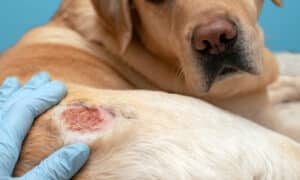
harm my dog? Fleas feed on your pet's
blood and make your dog uncomfortable A heavy infestation can cause it to
become anaemic and unwell. Flea infestations have been known to kill
puppies. Some individual animals are allergic to flea saliva and this
causes the pet abject misery with constant scratching and self mutilation. The most common allergy dermatitis in cats and dogs
is a flea allergy.
Read more on Flea Allergy Dermatitis. Fleas also spread tapeworm
from one animal to another.
Read more on Tapeworm in Dogs
Still having flea problems after
two weeks?
You
may still see a few survivors up to two weeks after treatment, especially if the
flea infestation was particularly
heavy. The reason you may see these fleas is because at the initial
treatment the fleas in the pupal stage have not been killed because of
their insecticide proof cocoon.
If after two weeks you still have a lot of fleas you will
need to repeat the treatment again in your house and on your dog.
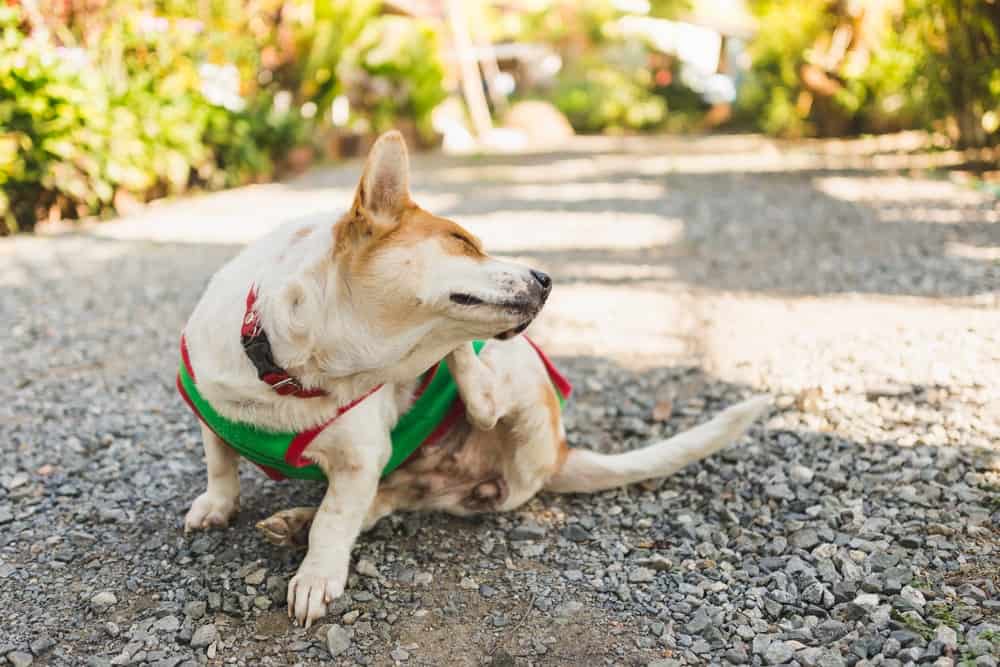
For maintenance... Keep an eye out for tell tale
scratching and act quickly if you suspect even a single flea. Re-apply
the top spot or flea product you have chosen or your veterinarian has recommended. Fleas breed very
quickly and two fleas can soon turn into hundreds.
A good way to check your dog for fleas is to roll him/her on his
back and check his groin area. You may see fleas scattering in
this area. Even if you don't see a flea you may see evidence of
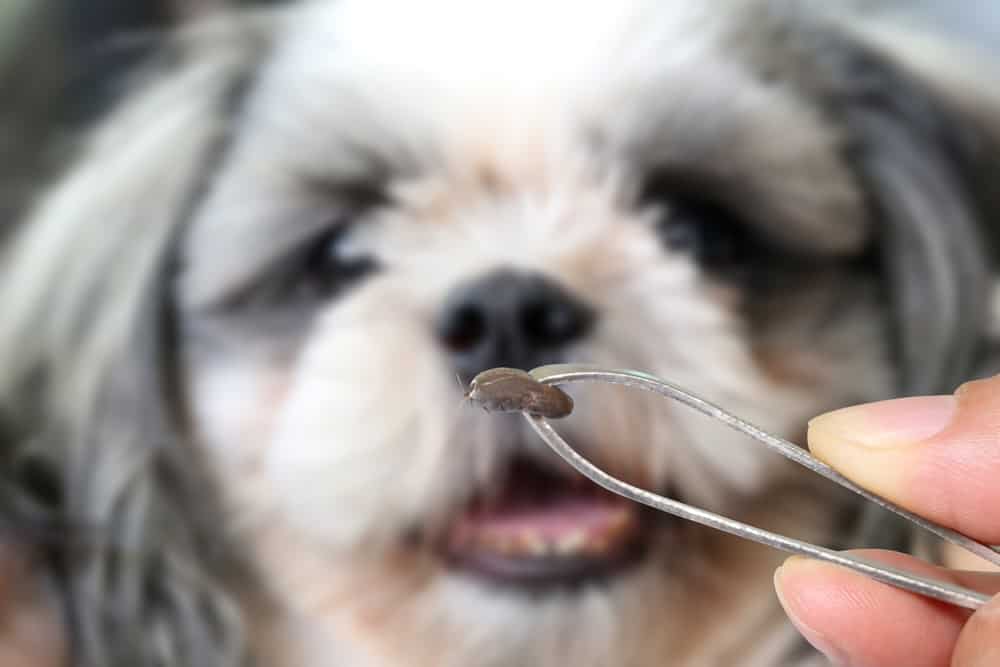
the flea's existence with 'Flea Dirt'. Flea dirt is
actually the fecal matter of fleas. It has an appearance
resembling ground pepper. Another favorite place for fleas to
congregate is at the lower end of the back right next to the
base of the tail.
Fleadirt
Remember, your vacuum cleaner is your best friend.
Vacuum well any area your pet goes. Wash bedding and toys often. Keep an
eye out for tell tale scratching and re-apply the top spot or product
your vet has recommended.
What is the flea cycle?
The flea population of any given area
comprises of 50% eggs 35% larvae 10% pupae and only 5% biting
adults.
Fleas lay their eggs after a blood feed on the animal
but these eggs quickly drop off on to the carpet, floor, bedding and
outside areas. In fact anywhere your pet goes becomes a battle zone.
The life cycle of the flea depends on temperature, humidity and
source of food. The life cycle of the flea from egg to adulthood can
vary from two weeks to eight months.
An adult female flea can lay up to 600 eggs in its life time.
Eggs can hatch anywhere between two days and two weeks.
After the eggs hatch they become larvae. These are little worm like
insects that get deep into carpet fibres, in cracks between floor
boards, under beds, furniture and rugs and around skirting boards.
They also thrive in sand and gravel. They feed on dead skin cells,
organic material and the blood rich faeces of adult fleas. Although
they don’t have legs they can move around and make their way to
corners and crevices
The little worm like larvae develop over
a period of one to three weeks going through four moulting stages
then spin themselves a silken cocoon, just like a caterpillar. This
is called the pupal stage. They can remain in their little cocoons
for several months but will hatch if conditions are right.
Vibrations can trigger them to hatch and this is the reason why you
can be suddenly covered by fleas after a house has been left
unoccupied for a long period of time.
It is important to note
that while the fleas are in their cosy little cocoon they are not
harmed by insecticides. The cocoons are watertight and protect the
developing flea. This is why you may think you have killed all the
fleas and larvae in your home but two weeks later a new outbreak
will occur.