Obesity in Dogs
- Help for your dog to lose weight
Excuses
are plentiful when it comes to the subject of obesity in dogs. It’s a
very touchy subject as many people take offense at the mere suggestion
that their beloved dog might, possibly, ever so slightly be on the
overweight side, let alone obese.
The
difference between humans and dogs is that humans have thumbs and can
open the freezer and take out the ice cream. Dogs can only eat what they
are given to them, therefore a higher responsibility is placed on the
owner to do the right thing and keep them lean.
Many people
subscribe to the “food equals love” theory and pass that on to their
pets. The dog isn’t going to say, “No thank you, I’m trying to watch my
figure,” so next thing you know the vet is telling you that you need to
get some of the weight off.
Bad weather
conditions can affect the amount of exercise our dogs get. We must take
that factor into account when the weather is against us, be it a hot
summer or cold winter. We must decrease the amount of food we give them
if we are going to decrease their ability to burn it off.
The “it’s
not me” excuse is a hard one. Dogs will learn very quickly exactly how
lucrative a high chair can be. People might feed the dog on the sly. It
is important for people to know that they are in actuality being cruel
to the dog by overfeeding.
It has been
proven that a lean dog lives an average of TWO YEARS longer than
an overweight dog.
|
The
emphasis of the number of pounds gained is another big one. One or two
pounds does not really sound like a lot. What people often fail to
realize is that it is not the number in pounds that is important. It is
the percentage of body weight that is the real issue. For example, on a
ten pound dog, just “one little pound” is ten percent of his body
weight. That’s equivalent to twenty pounds on a two hundred pound
person.
People
really shouldn’t be offended if told their dog is overweight. Society
has ingrained the fact that a fat dog is normal. There are even
overweight dogs used in television commercials. It’s not made obvious,
however, somewhere in the subconscious mind will register the fact of
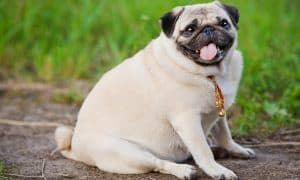
what a dog should look like. So when Rover comes waddling in for
breakfast, nobody notices anything wrong with him.
|
|
There have
been owners of dogs whose body weight was perfect that have run into the
vet’s office in hysterics because someone said their dog was too skinny
because society has been trained to see a heavy dog as healthy. And
healthy is the last thing that these dogs are….
How Much Should my Dog Weigh?
This is a pretty common question. The answer is, there really isn’t
always an answer. Just like people, the dog’s body structure is an
important factor.
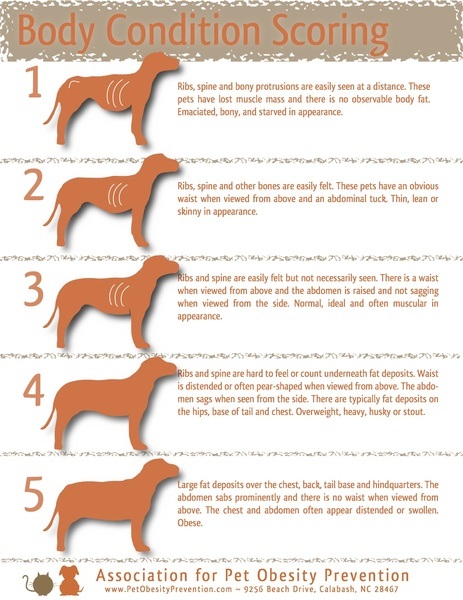
That being
said, the emphasis should be placed on the dog’s body condition score,
or BCS. One of the more common scales is one to five, one being severely
underweight and five being obese. Dogs on this scale should have a BCS
of three.
An ideal
BCS of three will be the following: Individual ribs can be felt easily
with one finger while sliding down the dog’s body. If pressure is needed
to feel them, there is a layer of fat covering them. If you can see
them, the dog is too skinny.
(While
true for the majority of breeds, Breed sites state that it can be
acceptable to see the last two ribs towards the dog’s back on boxers and
greyhounds. Vets should be consulted when determining the BCS of these
breeds.)
The other
indicator is the dog’s waistline, or lack thereof. The waist should be
thinner than the chest and the dog should have an hourglass shape when
looking down at the dog from above. If the dog is just a straight line,
then they are carrying too much weight.
Overweight vs. Obese
A dog is overweight when they are ten percent, and obese at twenty
percent over their ideal weight. This can be important to know when
owners and vets are implementing a weight loss program.
It’s also a lot easier to take weight off of a dog before they become
obese. The reason for this is that an obese dog may not be able to
handle a lot of exercise which is a helpful aspect of weight loss.
Obesity can
also be a result of numerous health issues. Dogs should be deemed
healthy by a veterinarian and cleared for a weight loss regimen before
beginning. Medical conditions such as hypothyroidism or diabetes that
can cause weight gain.
OK I Get It. The Dog Is Fat. So What?
Glad you
asked! As mentioned, obesity can be a symptom of some medical disorders.
It can also PREDISPOSE your dog for problems. What can it do?
The most
obvious problem is osteoarthritis. Every dog will get some OA as they
get older. If they carry around extra weight throughout their younger
life, the years of pounding on those joints will bring it on much
sooner.
Obese dogs can be more likely to get diabetes. Regulating their sugar
means a STRICT diet change. No telling the vet that they won’t eat the
special diabetic dog food. You will be giving them insulin shots twice
daily and regular trips to the vet for glucose curves to make sure you
have the sugar regulated properly. If not, other symptoms can develop
from uncontrolled diabetes. One example, the dog can go blind.
Pancreatitis is common is some smaller breeds like yorkies and
schnauzers, but can attack any dog. It is brought on by ingesting foods
that are too rich or fatty and usually come in the form of table food. A
dog with this disorder needs to be hospitalized for several days on IV
fluids and medications. This can be fatal if not treated.
Organ function is a big one too. It stands to reason that if the heart,
kidneys, liver etc are working overtime everyday, they will give out
sooner than expected. The organs develop within the dog and are meant to
do their jobs for that size dog. If we throw an extra ten to twenty
percent of the body weight at them…well they will do their best for as
long as they can until the day comes that they just can’t do it anymore.
The next issue is a partial tear or complete rupture of the cruciate
ligaments. These are the ligaments holding the tibia to the femur.

Extra weight puts extra stress on this ligament. When we see it in a
younger overweight dog, it is usually a trauma or poorly judged turn. In
older obese dogs, after years of additional stress it can degenerate and
just snap.
Cruciate ligaments are repaired surgically and are REALLY expensive. And
here’s the best part. An overweight/obese dog that has torn a cruciate
is more likely to break the OTHER one! We’ve already mentioned the extra
stress on the knee, but what happens after an injury? They will put
even more weight on the good leg.
How Do I Help My Dog Lose Weight?
Well, the obvious way is through proper diet and exercise. After your
vet has ruled out any potential medical issues, and has stated that a
weight loss program is in order, ask his/her advice on where to start.
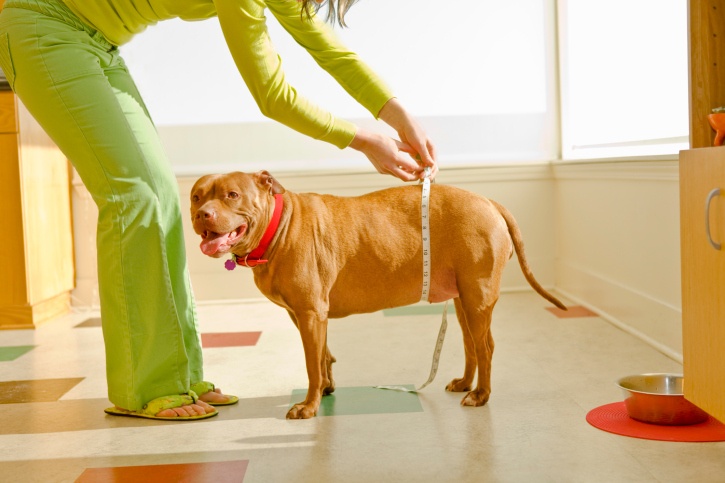
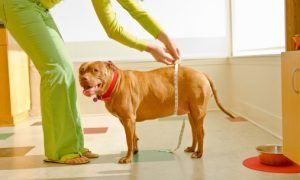
The single most important factor when trying to lose weight is to weigh
the dog regularly. If not, you could be slowly climbing and then the
next year when you see the vet you’ve added another pound or two.
If he is the same or more, you need to make another adjustment. If he is
down even a tenth of a pound or so, keep doing what you are doing and
continue to gradually increase exercise.
Weight Loss Options: EVERY option includes a gradual increase in
exercise. When increasing exercise remember that just like people, if
they aren’t used to it, they can get sore.
Eliminate table food and change treat protocol
Remember that weight gain is simply that the dog is taking in more
calories than they are burning off. If your dog isn’t too overweight,
most of the time the problem can be solved simply by eliminating table
food and reducing the amount and changing the type of treats that you
give the dog.
Would you
believe that an ounce of cheddar cheese for a twenty pound dog is the
equivalent of a human eating two and a half hamburgers OR one and a half
chocolate bars!
And some of the dog biscuits on the market are the equivalent of us
eating a snickers bar!
So changing the treats we give them will be a big help. Baby carrots,
raw string beans and celery (remove the strings) make good treats and
don’t have a lot of calories.
Light Dog Food or Prescription Dog Food
If that’s not enough, a diet change is in order. You also want to make
sure that the food you are currently giving your dog is appropriate for
the current life cycle. A dog from one to seven needs adult food and
over seven needs a senior formula. Ask the vet if you should go to
senior or light. The amount of extra weight involved and potential or
current medical conditions may be factors in determining that.
When
changing a diet, it is important to gradually wean the dog over in order
to avoid gastrointestinal upset. Start with three quarters of the old
food to one quarter of the new for a few days, then half and half, and
finally three quarters of the new food to one quarter of the old.
As far as
picking a food for your dog, your vet can help with this. Many brands do
have some sort of weight loss formula. The important thing to look for
on a bag is the word “light.” This means that the company has met the
requirements of the Association Of American Feed Control Officials (AAFCO)
to label their food as a weight loss diet.
Labels like “reduced calorie” or “low fat” are generalized terms and
open to interpretation. A diet can have five calories less and still
technically be “reduced calorie.”
Your vet
can also help with a starting point of how much to feed your dog at each
meal. Changing to a light food won’t do a whole lot if it is overfed.
The above advice about treats and exercise will still hold true.
Your dog
may not be a candidate for a light diet if they are obese and per your
vet at risk for some of the disorders above. They might need to take the
weight off sooner. In this case the vet might recommend a prescription
weight loss diet. These diets are only available from a vet. They are
low calorie, low fat and high fiber. The dog will feel full and be
taking in less.
You will
again need to get an idea from the vet on how much to feed the dog. Keep
in mind that as the dog’s weight decreases, the amount may change.
Discuss the amount you are feeding with the vet at your regular weight
checks. A dog can lose too much weight if the amount is not adjusted.
The use of Medication to help your dog loose
weight
If you’ve tried thee above methods, or your vet feels that the weight
should come off quickly for medical reasons, there is an additional
option. Perhaps you are in the situation that no matter what you do,
someone just won’t listen to you and stop feeding the dog. Or those big
sorrowful hungry eyes staring at you are just killing you. Maybe you
free feed and have other dogs. (This by the way isn’t a good idea. Dogs
should be fed scheduled meals preferably breakfast and dinner.)
For these
situations, or others that your vet might feel are significant, Pfizer
has come out with a prescription medication called SLENTROL. You will
need to discuss this with your vet to see if your dog is a candidate.
It traps some of the fat in the intestine and sends a message to the
brain that the dog is full. They will eat only what they need to eat.
Many owners are quite surprised to see their dog’s actual intake
requirement. There are important things to know when using this
medication.
First, tell
your vet the food that you are feeding. I know offhand that one of the
prescription diets is not recommended with this medication. The dogs
might not get enough calories if using that diet with Slentrol. Your vet
will be aware of this and have you adjust or switch if needed.
Secondly,
you MUST weigh the dog every thirty days. This is absolutely imperative
as the dose of the medication will start to change as the dog’s weight
changes. The vet will have a program in their computer that will
calculate the new dose based up the new weight.
And lastly,
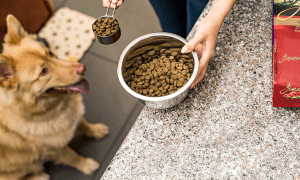
you must measure the amount of food you are giving with a measuring
device. No handfuls, scoops, or coffee cups. Use an actual measuring
cup. When your dog has finished eating, pour the remaining kibble back
in the measuring cup and subtract.
This will
tell you the amount needed for the dog. When coming off of Slentrol, the
dog will again eat whatever you give him. You will need to know how much
he actually needs so you don’t wind up back where you started.
This amount may also change as the dog’s weight goes down. Simply
recalculate any time they consistently leave food behind.
For more on Slentrol, visit: The
Slentrol
website
People to
realize that their dogs are in fact overweight and that it is a serious
problem. Your vet must always be consulted and kept in the loop of your
weight loss program. If you aren’t doing well, don’t get frustrated.
This isn’t an overnight process. As a matter of fact, losing weight too
quickly isn’t good either.
Your vet is
always there to help you and restructure the program if needed. Keeping
the vet informed will keep you on the right track and make sure that
nothing is important or potentially dangerous is overlooked.
Author: Jennifer Hanlon.
K9Einsteins
Professional Dog Training
|