
“This post contains affiliate links, and I will be compensated if you make a purchase after clicking on my links.”
One of the most popular devices used to restrain dogs when taking them out for a walk is the retractable leash. Many owners, however, wonder if such a leash is appropriate or even safe to use. Well, the answer generally depends on a person’s reason for using the device. While there are several ways to utilize the retractable leash properly, it is important to remember that they also pose some danger to you and your dog if not used correctly.
Before using a retractable leash, make certain you’ve got one that’s strong enough to handle your dog. Dogs that have a tendency to bolt or take off running after perceived prey should never be restrained with a retractable leash. Aside from those dangers, there are other things to keep in mind when using one of these popular leashes.
What You Need to Watch Out For
· Prickling leash burns. Retractable leashes, especially the thin string variety, can very easily cause leash burns. This could happen when you let your pooch race past you with the retractable line zipped up across your bare skin. Unwarranted injuries, however, can be prevented if you try the flat, tape style retractable leash.
· Entanglement or strangulation. Not only can retractable leashes burn us, they can also get twisted around a dog’s neck or legs. Worse, if your pooch panics and jerks the moment they get hog-tied; it could cause the leash to pull even tighter. Although you can loosen the cords that have wrapped around his neck, the situation could quickly become life-threatening.
· Fatal accidents. There are times when our dogs dart away all of a sudden, and with a retractable leash on him, your dog might dart even farther, faster. Nevertheless, it’s the reeling that’s a serious issue here. It is possible that Fido may spot a squirrel or anything interesting across the street, and suddenly take off after it. If you’re not alert enough, his abrupt behavior and an un-sturdy retractable leash could put him smack on the road, right in front of a speeding car.
Other Things You Would Never Want to Happen
· The leash drops. Because these leashes rarely have a wrist strap and are sometimes heavy and bulky, dropping them is a regular occurrence. What’s worse, if you drop the handle, the lack of tension can send the heavy handle hurdling toward your dog. Not only could the heavy leash handle smack your dog in the head, if your dog is spooked by the leash handle zipping deafeningly toward him, he may take off running.
· The cord is grabbed. If you grab the cord/tape while it is being pulled from the handle, you might suffer from immediate injury like cuts and burns.
· The cord wraps around you. Poor handling can also cause the cord/tape to twist around you or someone else’s fingers resulting in deep wounds, or worse, amputation.
· The collar breaks or comes off your dog. The moment this occurs, the leash could retract at top speed while the other end of the line whips around at the same full momentum leading to serious injuries to face, teeth, and eyes.







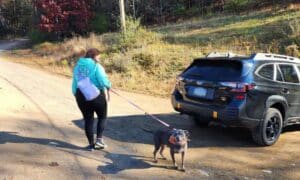










[…] as this perceived freedom can be confusing for your dog. The Dogington Post’s story of the Dangers of Retractable leashes gives owners much to think […]
BONNIE
says:just got back from my walk with my Chihuahua. It was pleasant until my neighbor came out of her door with her bulldog and HUGE Great Dane. She had both dogs on those dreadful retractable leads. .
The dogs rushed toward us and wrapped Elle and me around the leads. I held Elle high and was yelling at the neighbor to help us. She finally got hold of her dogs and we were free. Her dogs are nice but Elle was scared
and a terrible fight could have happened.
I don't normally holler at neighbors, but I hollered at her to look
online about the dangers of these retractable leads.
There are places in California that ban these Flexi Leads.
I wish Fairfax Co, VA would ban these leads!
People and dogs have been hurt badly using these leads.
I don't understand why anyone would use these leads anyway.
Dogs are known for sticking their noses in some pretty gross stuff, and sometimes even eat it.
Then they may just come and give you a big sloppy kiss!
A dog on a Flexi lead is too far away for the owner to even see what their dog is getting into.
Anyone who uses these dangerous leads should have plenty of insurance! If we had been hurt they would have had a large lawsuit on their hands!
nan
says:I currently have a third-degree friction burn at the base of my finger from one of these things. It’s going to take months to heal, and the finger is stiff. Any deeper and there would be serious nerve or tendon damage, and possible amputation. I was being careful but the dog (old and near-blind) thought she saw another dog and lunged, while I was trying to scoop her poop. Luckily no harm to her.
Having switched back to our old lead, I can also add that communication with it is much better – the extensible one was just too slushy. She prefers the real leash, and I won’t touch another of those retracting nightmares.
[…] as this perceived freedom can be confusing for your dog. The Dogington Post’s story of the Dangers of Retractable leashes gives owners much to think […]
Ann Hall
says:All things mentioned in this article could be said for ANY type of leash
Dora
says:My dog took off after another dog, and I fell. As a result, I tore my rotator cuff, and had a costly and painful surgery to repair it.
TJ
says:Haven’t had a chance to read through the other comments, but one of the things to keep in mind when selecting/using any leash are your local bylaws.
Some municipalities have restrictions on leash length when walking on public sidewalks/paths.
Using a retractable leash extended beyond the “legal” length can result in significant fines.
Katie W
says:I use a small retractable leash, specifically mad for Chihuahuas for my youngest dog(which she is a chi) whenever I walk her and being so small and dependant on staying at my side I have no problems. 🙂 For my other dogs, who are med size and mostly outdoors, I use a normal leash as they are likely to try and dart off. In fact sometimes it feels more like they’re walking me(especially when they go on walks together).
Gina
says:We have a small beagle – 22lbs and were using a retractable leash for her. Just as mentioned in the article, she saw something, darted toward it, and pulled the leash out of my daughter’s hand. She went around a corner, and my daughter lost sight of her. We live in a very wooded area, and after a 2 days search, we found our beagle tangled up in the creek through the woods. Thank goodness, the leash tangled up and kept her from drowning, but it had her trapped in the creek for 2 days. Good and bad – it kept her from getting swept away in the deep creek and stopped her so we could find her, but it also held her down and could have subjected her to being attacked by snakes, coyote, foxes and the other wildlife we have in our woods. A lot of people told me to buy a new, fixed length regular leash, so that’s what we have now!
Pierre
says:I have used this type of leash for 23 years. With my previous dog a Labrador Retriever mix for 15 years and with my present dog a Golden Retriever. No problems and I love it. I have used the big model(2), no thin cord.
However, I would use this type of leash only with mild mannered dogs. Both my dogs have been well Balanced dogs and I have not encountered any issues.
Of course there can arise problems with this long leash but the problem is not the leash but the people who do not know how to use it properly.
Jody York
says:To the woman who said us small dog owners would try to have your Akita put down if he bit one of our dogs object to that at least for me anyway. I have 4 dogs a as you put it yapper, I refer to them as ankle biters, 2 med mixed mutts and a black lab/ pit/ chow mix. Now if I’m stupid enough to let my lilman run up on a dog large enough to eat him or break him in half with one bite then I am responsible for that but if and it happens to the best of us we are passing each other and my yapper barks at your Akita n your Akita is having a dog day and bends his head down and bites my boy I’m going to blame you, not the dog because he is just being a dog n there is a pecking order amongst animals. If a vet is required I’ll hold you accountable for it again not the dog.
Now the reason I said it does happen to the best of us is due to my l/p/c mix she is a registered device dog due to medical issues. We were at the park once and a pos was yelling at a person and she was watching well when he resided to punch this woman in the face my Miss Kitt broke free and jumped on the person beating up the girl she went almost to the bone when she bit
So remember it does not matter by who or how an animal is trained shit happens. By the way 3 of the 4 I use the retractable leash however if I see someone headed my way I draw them in and that’s not hard to do
There was a neighbor couple who bought an 8-week-old American Bulldog puppy. At the time of purchase, they also bought a retractable leash based on the puppy’s size and weight, with no thought about 6 months later. So 6 months later, I was walking my dogs past them and this now 60 lb. young bulldog wanted to play with my dogs. He popped that leash in a split second and that dumbass couple were chasing their dog in circles trying to contain him, all the while apologizing to me and looking puzzled as to how their dog was able snap his lead.
On another note…
I just posted to my blog expounding on another aspect of these ridiculous leashes. As part of my post, I linked to your blog for further info. Please let me know if this is okay with you and if not, I’ll lose the link. Thank you… Hal
Jane
says:I don’t see anything wrong with the retractable leashes. I have 2 German Shepherds. I have used them for 8 yrs now. I have never had a problem, except the usual leash burns on my ands. I also have my dogs trained to walk with me. Not in front of me and not behind me. My dogs are also trained not to run or chase cats or anything else. They do ot tug on the leash nor do they run free. they don’t try to. You need to train your dogs to do what you want. It is possible. t is of course gonna take a lot of time and patience. Until you do this your dog is the master and does what he wants to, mainly because you never took the time to make your dog, yours. There is no excuse for not having an obedient dog. I have trained my own dogs and others. I am always complimented on what good dogs I have.
Taylor
says:Since your dogs are so well trained you don’t need a retractable leash.
Terri Conger
says:Yep! I’ve had the leash burn and the dropping of the handle. I sure don’t think it’s something to write an article about. People need to start taking responsibility and stop always blaming the product.
Lisa
says:Actually, have some pretty funny stories about my dog and the retractable leash. Burned the HECK outta my pinky finger with it!! Heck of a war wound, and with the scar, I know have the pleasure of saying “My dog, 2013, I was there!”
The second one is, I had her locked down, and was NOT paying attention to her. All of a sudden I’m flying through the air, landing on my side and being dragged through a yard! *LOL!!!* Needless to say, I got rid of it. 🙂 It was fun though! Thanks for the warnings!!
Laura
says:Having been injured by others using retractable leashes, I would like them banned. But that isn’t a reality in this country. My pug got attacked by a pit years ago because the pit was on a retractable and the owner didn’t have good control over him. I saw a child almost get strangled because her mom was more interested in her cell phone call than controlling her dog–thankfully a passing stranger saw what was happening and called an ambulance and the child survived. Personally, I wish this country would implement a maximum leash length standard as they have in certain foreign countries–4 ft max length. Again, that’s not going to happen. So those of us who are concienteous must keep putting ourselves and our canines in harms way because we have a lot of irresponsible people who use retractable leashes without any regard to the safety of others.
Dave
says:The nanny state is NOT the answer. Take responsibility for yourself. Buy the right tools and learn how to use them! If idiots misuse these leashes and hurt someone else or their pets, they should be sued and bankrupted. That will teach them the proper lesson. That’s what lawyers and courts were meant for. You hurt someone, you pay, as in with car accidents.
If someone had that threat hanging over their head you can be damn sure they won’t use one while texting, talking on a cell, drinking coffee, smoking, or whatever else can distract someone. Walking a dog is like driving a car. You’re responsible for yourself, your pet, and all those around you that could be affected by your pet.
The attitude you espouse is analogous to forcing everyone to drive a Prius. Not likely! You want one, you buy one, but let me walk my dog as I see fit.
Kent L. Aldershof
says:Who gave this mouthy broad the wisdom to know what is best for everyone else, and the authority to decree what other people should or should not use?
Her inability to manage an animal on a retractable leash does not justify her publishing a broad condemnation of the appliance for everyone.
Yes, of course it requires some degree of skill to handle such a leash, and a greater degree of attention when the dog is moving more widely than being confined by one’s knees. That is true of everything from a toothpick to a jet airplane; and people should use them only if they have acquired the skills, physical capacity, attentiveness, and care to avoid injury to property or to people.
However, it is the worst kind of hubris — i.e., overweening arrogance — to point out how a toothpick, or a knife, or a car, or anything else might cause problems if mismanaged or misused … and then to issue a blanket condemnation of the item being considered.
The most polite thing I can say to this intrusive woman (and to those who rallied around her plea to ban the retractable leash) is that it’s none of your damn business. If you are too incomepetent to use one, or so stupid that you will let it injure yourself or someone else, then stick with something simpler that lies within your limited abilities. Beyond that, shut your bitching mouth.
Lissie
says:Mouthy broad? Just because she has different opinion than you? I would rather take asvice from her than an opinionated jerk!
Bakakiba
says:Misogyny much?
hahahaha. well said. thanks.
Caroline Burton
says:Why is everyone splitting hairs? It’s the dog, the leash, the owner? Just accept this article for what it is, a valuable warning about retractable leashes!
g
says:I saw the most tragic accident at a dog park–it was a Special Day for dogs that day..a lady was walking her beautiful boxer and let him have as much line as he could to run among the bigger dogs..lots of greyhounds, mastiffs….then…the boxer lead wrapped around a greyhounds leg and he took off trying to get it off of him..meanwhile the boxer was being thrown in the air and swinging side to side and being choked at the same time!! The owner of boxer jumped on top of her boxer but still choking and the poor greyhound was now having his leg cut…..everyone was in a panic but finally 1 guy jumped and cut the leash line from both boxer and greyhound!! Both were taken to a vet to be checked out…..Please Share the Danger of the Retractable Leashes…Share the Dangers!!
Jane
says:I always walk my dog to the park on a short normal leash so I’ve got more control and can keep him away from the road then once at the park I switch to a retractable leash and am always aware of my surroundings, if people are about then I get him closer to me and click to make the leash shorter. It’s a no brainier really if using one of these leashes.
mandy
says:Personally, I am not a fan of retractable leases and would never use one. My dogs are large and could snap the leash in an instant. That isn’t the reason I dislike them, however. I dislike the retractable leashes because of the owners that use them. It has been my experience that owners of retractable leashes let their dogs get a good distance away from them. Their pet is often not disciplined and will run up to “greet” new people and new dogs. The owner makes the false assumption that this is okay. It is not. This is especially true of little dogs. Owners of the little dogs often think they are cute and adorable and, since they are too little to do any damage, they let them behave aggressively. I can’t tell you how many “little dogs” I have had run up on me or run to the end of their retractable leash, barking their head off. When I have an aggressively postured yapper at the feet of me and my 100+ lb Akita, who is never further than a foot from me mind you, it kills me. I have to work hard to keep my boy’s focus on me and not the dog. Half the time, the owner is on the phone or distracted, not paying attention or concerned. Often they give me a duh expression or smile or try to make conversation about the dogs. A few times, the owners left it to me to physically remove and return their dog. Now if my dog barked back or bit, it would be a problem. Even though the little dog started with the aggressive behavior to begin with. It makes me angry and upset just thinking about it. You folks on here say it’s about the owner, not the dog. Sadly, there are more irresponsible retractable lease owners than responsible. People who think that because their babies can’t hurt anyone, that they can let them do as they please. This is the majority not the minority. Those are the same idiots who would push for my dog to be euthanized if he bit or killed the dog who ran up barking at us.
Jen C
says:I completely agree with you Mandy! Again, I am a professional dog walker and I own a small and large dog. I can attest that it is the irresponsible owners that want their dogs to have all the freedom in the world and are upset when I tell them that I won’t walk with retractables. It is also those people that let their dogs run up aggressively to my dogs and then ask me to get all of the dogs under control. What are you people thinking!?!
Jody York
says:Read the post I just put on here please thank you
Fido
says:Leashes don’t kill people..People do.
christine
says:I had to read this article because I had bought a retractable leash because my dog had seriously hurt my shoulder with a regular leash. She had lunged forward and jerked my arm out of it’s socket, I had to have physical therapy for months and still have pain and limited movement now. So I got the retractable leash thinking it wouldn’t have jerked my arm and I would have had time to either slow her down or let go.
mandy
says:If your dog is a puller or lunger, you are likely to have trouble with the retractable. I have seen them both break and be pulled out of the owners hand. You may save your arm at the expense of losing your dog. And whatever the dog is lunging at.
Sandra
says:Good one, Dan.
Dawn
says:The worst injury I have ever seen was due to the use of a flexi and a head harness. At a local park an owner was walking the dog on the combo. A bunny darted out, the dog took off after the bunny down a hill, hit the end of the flexi hard which snapped the dog around and over onto its side. The dog was unable to get up and move and the screams were horrible. I do not know the people so I dont know the end result, but all the witnesses, who helped get the dog out of the park and to a vehicle were fairly certain the dogs neck was broken. Had the dog either been utilizing a regular leash and head collar or a flexi and a normal collar I am sure there would have been no problem.
Rachel
says:If your dog is away from you and you need to suddenly pull your dog in then it is not possible with this type of leash. The only dogs that should be on this type of leash are those they are highly trained to heel immediately on command, and in areas where there are no other people or dogs that could detract them from this normal trained behaviour.
One thing to add. Please please dog owners. If someone says they don’t want your dog to come near them, then please respect them. Don’t just say “they are friendly” as there are many reasons why a dog approaching them could be upsetting. If your dogs will not come to you immediately and insist on approaching strangers then please keep them on a leash. I love dogs and used to have two malamutes, but they were always leashed and under my control and I would never let them approach someone unless that person asked if they could see them closer. Also, if an area says dogs must be leashed, or no dogs allowed, respect the law. There is usually a conservation reason for these rules.
Thanks
Jody York
says:Unless it is a service animal licensed and registered but do keep them on a leash for their safety as well
Breckyn
says:I work as a Veterinary Technician, and work with a non-profit rescue. They have a variety of different dogs, some with behavioral issues. I had a Rottweiler come in one evening (Not using the breed as an example, just the size) and the foster home had it on a retractable leash. This dog had aggression issues with some men, and I just fell into the type that she had issues with. The dog charged me and when she tried to jump up, the foster went to stop the leash, and the power and pull behind the dog caused it to snap. I was able to get out of the exam room in time, but if I hadn’t, there could have been a serious injury involved. These are NOT safe, and although it may be good for your dog, and your dog may not have any socialization issues, not everybody else’s dogs are the same.
Heather Monique
says:I completely agree with Kat Crow. I also have two mini Dachshunds. We have used the retractable leashes with harnesses for years without any problems. It’s like anything else that we use. All the gun nuts keep saying, “Guns don’t kill people, people kill people.” Well, the same kind of logic can be applied here as well. The retractable leash is only dangerous in the wrong hands. I prefer it over a standard leash because it gives my dogs a little sense of freedom but still assures me that they are safe. I’m sick and tired of the stupid people in this world ruining everything for the rest of us by either not following the instructions or just flat out being completely crazy. Unfortunately, it seems to be only getting worse. This article is merely common sense.
Anita C
says:There ya go, Heather. 🙂 The minority is always wrecking things for the majority. Most people use these tools responsibly, but it’s the clueless few idiots who ruin a good thing for everybody else!
The article does a good job of pointing out the pitfalls to the clueless minority who may not give it any thought. But then, heck. They have to read the article first to get educated.
Jen C
says:Unfortunately, it is the MAJORITY of ppl ruining retractables for everyone. I own a successful dog walking business. Most of my clients walk with retractable leashes, but most dogs simply are terribly behaved on them running 10 or even 20 feet ahead of the owner totally out of control. In fact, my employees and I carry our own 6 foot leashes to walk the dogs. And that is my official rule because any time I have been hurt – it has been due to a dog jerking on those flimsy things. I have also been badly cut by them. I do not think they should be banned since it is true that it is up to the owner for the dog to be under control – but I certainly won’t take the risk. It just does not make since that you can always control every dog that is 10 feet out ahead of you! Be very careful!
Jen C
says:P.S. – I have also seen a dog walking with their owner in a complex. The dog lunged, the owner hit the lock down button, and the retractable snapped. The dog was hit by a car right in front of everyone. Very heartbreaking! I wonder if a regular leash would have prevented this! I guess we will never know…
Dan
says:I guess the best way to take your dog for a walk would be to use a car tow chain. Hopefully, no one will get the tow chain will be large enough so that no one will get it wrapped around their ankles or legs to cause burns. Hopefully the tow chain will be heavy enough that the dog won’t be able to run away with it if you drop it. Hopefully the tow chain will be large enough so it won’t strangle your dog. Hopefully the tow chain will be large enough so that it won’t cause someone to not see it and thus ride their bike across it path. Hopefully everyone will get their tow chain cut to a four or six-foot length so they won’t get fined. Hopefully, everyone takes their tow chained-dog for a walk way out in the country instead of around town. Hopefully everyone spray paints their tow chain with reflective paint so it can be seen at night. Hopefully everyone will call all other dog owners within a 50-mile radius to notify them that you’re going to take YOUR dog for a walk…and no other dogs should be in the vicinity. Hopefully, every dog owner will go to their local junior college and enroll in a physics course so they can understand the physics of a speeding bike, and something getting caught in the front wheel mechanism, bringing the bike to a dead halt and knowing that the rider continues to move, even though the bike has stopped. Hopefully, everyone knows that I’m being sarcastic here with all of the above. If the person holding the leash is an idiot…bad things will come out of it. Bottom line…be responsible. I know that’s something people now-a-days have a hard time doing or understanding. They always have to find someone or something else to blame their stupidity on.
Michael H
says:Get Real I have a mastiff/Labrador and a shepard golden/ retievor I walk them at the same time with two retractible leashes. they have a lock you let them out x amount of feet and lock it. when people come up the bike path I reel them in to less than 5 feet and lock it. Have arthritis and have control with the handles. Bike riders shouldn’t worry about about hitting a leash worry more about hitting a dog that weighs 150 pounds. I have a hard time believing
a person cant control a little dog. Buy a gentle leader and use it with it.
Suzan Cummings
says:I have used both a 6 foot leash and a flexi-leash on our 10 pound mini-dachshund. Where we live we have an island in the middle of the road of our complex. I keep it short while walking to the island, then let it out so she can walk on it. If I use the shorter leash I have to walk on the island and not on the street and dodge the land mines that other dog owners don’t clean up. The flexi-leash is just long enough for her to walk on the island in the grass where it’s safer than on the street, and she can’t go on the street on the other side. but I can stay walking on the road so I don’t have to worry about stepping in anything. If anyone comes along walking, walking their dog or riding a bike I pull her closer and shorten the leash so she can’t tangle it around anyone. Knock on wood, we haven’t had any problems. I think it’s just a matter of being responsible and paying attention. My flexi-leash is neon yellow so you can see it from very far away whether it’s light or dark and the handle is reflective making it safer to walk after dark. I do only use it with a harness, I won’t walk her with a collar because I don’t want her to injure herself when she pulls. The harness I use is petco.com/product/118860/Petco-Adjustable-Mesh-Harness-for-Dogs-in-Pink.aspx which is much more comfortable and safer, other types she would step out of and trip being her front legs are so short. As with anything, I think you need to be sensible and responsible when using this type of leash.
Lisa
says:Suzan, I use flex leashes on both my dachshunds for the same reason you do. My dogs can be somewhat reactive, so they are only allowed to be slightly ahead of me, and I pull the leashes in if there are any people or dogs around. I always scan my surroundings for other people and any other dogs, leashed or not. I use a harness on both dogs–I agree that using a collar is not appropriate–and the halters are much better for a dachshund’s back. I NEVER bring my cell with me on these walks. I concentrate on the dogs, and I have never had an issue. They have worked quite well for me. In our neighborhood, loose dogs are really the biggest issue.
My sister has a chihuahua and from the time he was small she never taught him obedience.He has went after ppl and he’s 15 ft away. I have grabbed the leash to get him back and nearly cut my hand. If your not a responsible owner leave your dog @ home. I have taken him for walks a few times but,I refuse to use anything but a short leash. He minds pretty well for me but she continues to let him do as he wants. I don’t go for walks anymore with her because she doesn’t listen and he is going to bite someone. Not my problem though! She won’t listen!!!!!!!!!!!!!!
jim andrew
says:Retractable leashes don’t kill dogs; cars kill dogs 😉 I use a retractable leash and have never had a problem. Maybe because I’m a responsible dog owner.
Charity
says:As a dog trainer, I recommend a 4ft leash period. You have complete control and the dog learns to heel and not walk ahead of you. While I would not ban flexi-leads, I don’t condone their use except for the very few who have posted that they actually know where and how to use them. Most folks do not.
LK
says:Agree with the posters that say the retractable leash can be very effective and enjoyable when used properly. I do believe the dog should be trained to walk on a regular leash before allowing them the freedom of the flexi lead. All the flexi leads have a button to lock the length so your dog cannot go further than you want. You should always be aware of where your dog is and where danger (human, animal, cars or other) may be so you can keep your dog away from it regardless of what type of leash you have. We’ve used flexi leads with 5 dogs and none has had an accident or injury because of it. It just takes common sense and being aware of your dog and your surroundings.
Kat Crow
says:I have used a retractable leash with my two mini dachshunds for years! I disagree that one does not have control with this type of leash, my dogs are in MY control the entire time I am walking them. I pay attention and shorten the leash to prevent accidents. I also use a harness with the leash instead of a collar. These leashes work well with my dogs, once again, they are small dogs and I PAY ATTENTION!
Valerie
says:I use a flexileash with my 2 dachshunds and have never had a problem, however when i walk the I don’t let them have all the leash. I extend it about a foot from me so they have some room but usually they’re at heel position when we walk. I’m to scared to let them run loose leashe because they bolt after anything they precieve as prey. And i do see people who let their dogs run all over with flexis
Teresa
says:Before our fence was completed I used a retractable leash with my dogs. I only used it in the backyard for potty time. Whenever I take my dogs outside where there is the potential for other people or animals to be around I always use a 5 foot leash that also has a traffic grip. I get very annoyed when I take my Huskies to the pet store and there is a person with a small dog on a fully extended retractable who is not paying attention to their dog.
Jeanne
says:I use a retractable leash with my dog all the time but I always have him in control. Around other dogs I keep the leash locked so he is walking beside me. I also use it as a training tool with my dog for the times he isn’t walking as nicely. I “lock” him in at a certain distance and when I choose to I unlock it and discover that he is walking a lot better. If I am on my cell phone (which is barely ever and currently is only because of family emergencies these days) I keep his leash locked at a distance of a regular leash. When used properly I think retractable leashes are great!
Ashlee
says:My lock broke and my dog ran and was killed! So be careful!
Jessica
says:Just like everything else, use common sense. Don’t blame the leash, blame the person using it.
marianne
says:Also in elevators it can be a nightmare. You in the elevator and your dog outside of it being strangled when the elevator starts to move
KM
says:That is a ridiculous scenario. Even if it was possible, it could happen with regular leash too. Having said that, if someone is that careless or stupid, they shouldn’t have a dog.
Kim
says:Every single bad dog walking experience I’ve had has been with someone using a flexi leash. You simply cannot control a dog 15-20 feet out in front. Also, I know from my own personal experience, that you can easily drop the handle or have it pulled out of your hand if your dog lunges or pulls in response to a stimulus. I don’t care how good you think you are with your flexi leash, accidents happen. Just like the time a neighbor’s dog lunged toward me and my dog and she dropped the handle on her flexi leash. The dog then proceeded to wrap the cord around my bear ankles and cause deep cuts. I still have scars. Flexi leashes were NEVER designed for normal dog-walking. They were developed for tracking.
Jessica
says:I’ve got a rope burn healing on my leg now from where a doxie’s owner let her dog wrap around us both.
It was semi-amusing at first as our dogs were trying to sniff butts, but when the other owner panicked, her dog nipped mine and took off. I ended up having to step on the leash to slacken it enough to free my leg.
I’ve noticed they’re (now) walking the doxie with a normal leash and not the retractable one.
Cheryl
says:I just got my first dog ever, yay! But have been walking and training others dogs most of my life. The danger of the flexi is in the handler. I like them, actually they are my leash of choice for the reason most don’t use them for. If I am around people I lock the control to keep the dog in heel position. If not crowded sidewalk I release more leash. Goal is control.
I have had my dog one month and she already knows to walk leaving slack in the leash. I second the caution to avoid those with short flat leashes that change to cords. I also use a harness.
Another personal pet peeve is owners on the phone oblivious to where their dog is.
Channin Dallas, TX USA
says:I agree totally with your comments. I would also add that I would not use a retractable leash on a dog that I did not know very well. My dog and I used one successfully for 14 years without incident. I too was annoyed with people obliviously walking their dog while on their cell phones. (Most likely those are the people who don’t pick up after their dogs, they have one hand on the leash and the other on the phone. UGH) Personally, for me walks are a bonding time. I would not have used a retractable leash if my dog was a “puller” Plus I could control my dog with my commands if needed.
Pamela
says:Another related danger not mentioned cn happen when the dog takes off running, and the owner clicks the latch to stop it. This jerks the dog up short, and if the dog is wearing a collar, it can cause choking or neck injury. If a flexi leash MUST be used, it should be used only with a harness that does not fit snugly around the dog’s neck.
Barb Canfield
says:I have successfully used flexileashes since 1982. I have never had a dog or person hurt. BUT I only use it in the open field with no other people nearby. It lets me always have control of hy dog in the wide open spaces. My dog can run and run, play fetch. But I ALWAYS can get her back to me in an emergenxy.I also use it while standing on my front porch to let my dog go out to the bathroom. She doesn’t wander out on the highway and get killed by a car. Coyotes cannot grab my dog away from me and other loose dogs cannot grab my dog either. But the flexi is not appropriate for crowded situations. That is when you use a regular leash. A tool like a flexi is only as responsible as the person using it. Like any tool, it is not appropriate on all situations. And you have to learn how to use it so you don’t do dumb things like grabbing the line.
I totally agree with u 😉
kelly Bee
says:I agree too. Thanks Barb — Used the largest flat for 2 of our dogs in the same situations you mention and worked great. Our 3rd dog it was definitely not appropriate & we did not even try.
Valerie Fox
says:I totally agree with you. If you don’t know the proper way to handle your dog on a retractable leash please don’t use one. Otherwise they work great.
Valerie
I want to add another point to this article. With a retractable leash a person has no control over their dog at all. And this can create danger from other dogs
As the owner of a reactive dog when I am walking or running with my dog I move out of range of the other dog. But more than once I have had to dangerously move on to the road to prevent the dog on the flexi from getting in my dogs face ( as that is when she reacts).
I’m doing the right thing, my dog is leashed and controled but the dog on the flexi is more or less off lead.
Most by laws say a dog needs to be on a 6 foot leash. Walking on a flexi could get you a fine
jesse
says:Sorry, this isn’t true at all. all of them have some kind of “push this down with your thumb to make the leash not extend anymore.
Also, i’ve never seen anyone get a fine for one.
Like, i don’t really agree with them, and they do cause problems, but now your just making stuff up. Which i’m much less of a fan off.
Tammy Myers
says:You most certainly can get a fine if you have your dog on a leash longer than what is the law in your community. If the law states that dogs have to be on a leash no longer than six feet and your dog gets into trouble and you have him on a 15 foot lead, retractable or not, you can get fined. I dont see the need for these leashes anyway. My dogs are trained to walk at my SIDE, not out in front of me.
Diana
says:Like you should be the only one to have a dog because only you can control dogs! (Sarcasm). I don’t have a retractable leash now, but used to with my other dogs. They were fine and I never received a fine for having one either.
Barbara
says:YES. I have the exact same issue. My dog is reactive when dogs run up to her face (until then she likes them). So often the owners don’t lock the lead and what I think may be a short leash is suddenly 20 feet long. Also the cord is hard to see. I hate these leashes and even when I see a dog that I think my dog will get along with, if they are on a flexi, I walk the other way.
The worst thing about retractable leashes is the owner on the other end. There is no way anyone can have any control of a dog that is 15 ft away from them. The owner is standing there talking to a friend or on the phone and their dog is in the process of doing macrame with it’s leash cord around another dog, human or himself. Two dogs approaching each other on retractable leashes is a disaster on 8 feet just waiting to happen.
In my opinion, unless you are out in a rural area away from every other living thing, you should NEVER EVER put a retractable leash on your dog. I have seen way too many accidents occur with these things — mainly because they are not used properly or because the owner is distracted by something more interesting than their dog or its welfare.
durrrrhhh
says:Keyword: OWNER. The leash doesn’t cause any of this, it’s the owner’s own lack of responsibility. All these people are the same people trying to get 9/10 things banned in this world just because they are too dumb to use it/ afraid of other people. Grow a pair and learn some responsibility. I should be able to do WHATEVER I want if I can handle it.
Humpty Dumpty
says:What if you were not the irresponsible/ignorant owner? What if you get injured due to someone else’s carelessness? Would you want the product to be banned then?
HM Phobe
says:So, if a careless driver injures you, should we ban cars? Same logic.
John
says:The bike rider is just as much to blame. But of course we live in a blame everyone else society
Linda Rogers
says:I have used retractable leashes on 3 of my dogs for years and have not had the first problem, knock on wood. Our family uses them very safely and we are very cautious when have our dogs on them. We had a sheltie that would not walk on anything but a retractable leash so give some of us owners some credit for practicing safe walking habits and caring for our dogs enough to not let them get hurt.
Duke's Kingdom
says:I have a retractable leash for my doxie, he is a mini and weighs roughly 15 lbs. When he is taken out either by me or my husband he is given full run UNLESS there is another dog in the area, people who he can easily trip or it’s at night when coyotes are out and about, during these times he is locked down and kept at our sides or between me and my husband when we both take him for his little walk. He knows when we lock it down and doesn’t even try to lunge, he actually stops mid stride. Not every owner is an irresponsible person when it comes to these kinds of leashes.
Julie Baker
says:I have a Doxie also, and a retractable is the only leash i use. It is the OWNER that should use it properly, i have never had an issue with my 13 LB. dog.
Jonette Dangerfield
says:The point of a retractable leash is that you CAN give the dog freedom if you CHOOSE and the dog is trained and WORTHY of that trust. One of mine is and when we walk in a large grassy area and he wants to run a little, he can. I’m aware of our surrounding and the length of the leash. To say all users of retractable leashes and all dogs are a danger when on one is generalization at best. It’s a tool. Like any other tool, it’s pretty damn great when used properly by people (and dogs) who know how.
Theresa
says:I must use it properly because I have never had any problem with the retractable leash and I have 7 dogs.
Michelle
says:No way an owner can control a dog at 15 feet?????????? Maybe the people you know need better training. I can drop my dogs into a down from 100 feet or even 100 yards. retractable leashes are fine in the right hands and with a trained dog. Ive seen just as many dogs on leash rip the leash out of an owners hand and do something bad or cause injury… heck some dogs are dangeous… so should we just ban dogs too in the process? What a bizarre discussion. If people dont like them… so be it but to say they have no place? I even have my clients bring flexi leashes on week 6,7 and 8 to practice calling them when they are distracted to improve their recalls.
Mickey
says:John,
I appreciate your thoughtfulness as a biker. I try to do the same as a dog person. I live in a high altitude mountain town where bikers come to train. I live on a steep private road and bikers sometimes enjoy racing down that hill, which has a 15 Mph limit. They scared me many times when I take my dogs for walks. One german shepherd wanted to chase the bike, and she fortunately was on a long line which I rapidly pulled in, otherwise both rider and dog could have been injured. My latest dog is another shepherd, a pup, and I am training her to stay by my side until I get to an area where she can run around a bit.
When I see these bikers flying down my hill they are out of control, way over the speed limit and not watching for me or my dog. By the way, I am the only resident on my road. There are ski homes, but people are rarely around. Every home owner has a dog, so when people come up at Christmas, the dogs and the people has a blast. They are off lead and that has dangers as well. I try not to blame too much, as we ALL have to be careful.
Margaret Powell
says:My brother was seriously injured and almost killed by a neighbors retractable leash. H was rining his bike downhill at night and at the shoulder of the road was a mother and daughter walking their dog with a retractable. The little dog was on the other side of the road and the leash line was invisible. When my brother rode by it caught above the front tire and flipped his bike. He did a face plant on the pavement and was unconscious and bleeding with a badly broken nose. An ambulance was called. It was very traumatic for all of us, and he didn’t remember what happened for weeks. The ambulance bill and report finally came in the mail with no names of the mother and daughter. He is still trying to pay off the $10,000. hospital bill…..
jesse
says:A little dog weighed enough to flip that bike? What do you consider little? In the universe we live in as humans, i’m not sure that’s possible. Unless your brother is 60lb’s, his bike was made of air, and the dog was larger.
skloss
says:Why are you doubting her story?? Her brother was severly injured, and it was the dog walker who was in the wrong! Walking on one side of the street while the dog walks on the other is stupid and dangerous! The cord CAUGHT the front tire–THAT is what caused the flip.
KBK
says:I don’t think you understand the physics of a speeding bike, and something getting caught in the front wheel mechanism, bringing the bike to a dead halt. The rider continues to move, even though the bike has stopped. I have the scars to prove it and the culprit was a handbag strap.
Tammy Myers
says:It was the leash line, not the dog, that caught his bike.
Greg
says:No..I don’t think anyone understands. It wasn’t the leash, nor the dog caused this accident. It was the idiotic person on the other end of the leash. No need to ban the leash, or the dog…Let’s just ban idiots!
Chris
says:Yes, please let’s ban idiots owning dogs. Or at least educate them before they get other dogs, and people hurt and in trouble. Please.
Renee Mohan
says:One small piece of properly placed string, could easily take down a #300 person. . .s #7 dog jumped into the back of my knees & I hit the floor. (Not #300, but weigh LOTS more than The dog.) The Law of Physics.
durrrrhhh
says:Aaah the old false dilemma fallacy. Grade A writing. This is not even a complete article it offers nothing to help/educate people on how to actually USE the leash, it just says LETS BAN THEM/NOT USE THEM AT ALL. Just like you old timers/yuppies want to ban everything else you are afraid of. Stay out of other people’s lives, obamadrones.
Judy Byrd
says:Sicko makes everthing about national politics? go to your own kind of web site. Retractable leashes are a bad product, and a stupid fad.
Jim
says:Have to wonder if someone else was President who they would blame for the things that would have happened anyway, Clinton?
Ashlee
says:I would love to try and ban this leash. I was walking my two yet old
Dog and the lock came undone and he ran into the road and was killed by a bus. I started a Facebook and added this article. I just want people to be aware they are not safe our loved dogs and even people!
John
says:I’ve been riding a bike for 40 years, met many dogs, cars, kids, other animals etc, none of whom gave a crap about me. I learned to watch out for anything that might cause me harm. Blame the dog, blame the leash, blame the handler, I’d blame myself. For going too fast by a hazard I knew could hurt me.
If you’re that close you can’t react, and I approach all dogs expecting them to react and adjust my riding style accordingly. If I’m across the road, I have time to react appropriately. If I’m riding recklessly, well I get what I ask for sometimes.
Chris
says:A thin, long retractable leash has no place across the road, or across anywhere that people are walking. People who walk their dogs, especially in crowded cities, like NYC, need to keep their dogs on a shorter leash, unless they are in an area where the dog can run, like an empty field. Not the bikers fault, the owners fault, always.
Bill
says:How dark was it? How fast was he going? Did the rider indicate in any way to the pedestrian that he was approaching? Why could he not see the pedestrian on the road way with their dog? In order for the leash line to be invisible, it had to be pretty dark. No one should be riding around at night on roadways on a bicycle. Should the dog have been kept closer? Very likely. But to put all the blame on the lady with the dog is ridiculous.