“This post contains affiliate links, and I will be compensated if you make a purchase after clicking on my links.”
Contrary to its name, ringworm is not a worm at all but a fungus called Dermatophytes. Dermaphtytes means ‘plants that live on the skin’. But ringworm in dogs is commonly caused by the fungus Microsporum canis.
In the past, because of the circular lesions made by the fungi, they were thought to be caused by worms, hence the name ringworm.
The fungi live on the surface of the skin and in the skin follicles. And they feed on dead skin tissue and hair. So taking care of your dog’s health, especially their skin, is important.
Symptoms of ringworm in dogs
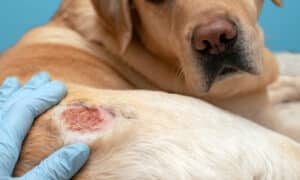
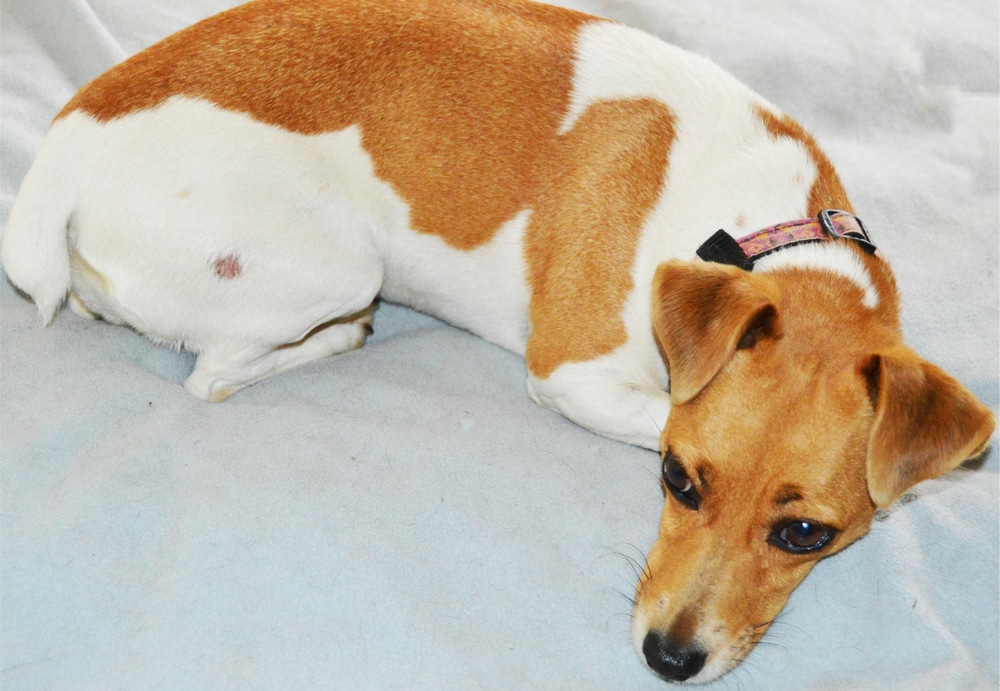
The usual symptom of ringworm in dogs is a round hairless lesion. The characteristic “ring” that we see on humans doesn’t always appear on dogs. This lesion will grow in size and often become irregular in shape.
The fungi causes the hair shafts to break off and this results in patches of hair loss. And the lesions are scaly and may or may not be itchy and often the skin is reddened and inflamed.
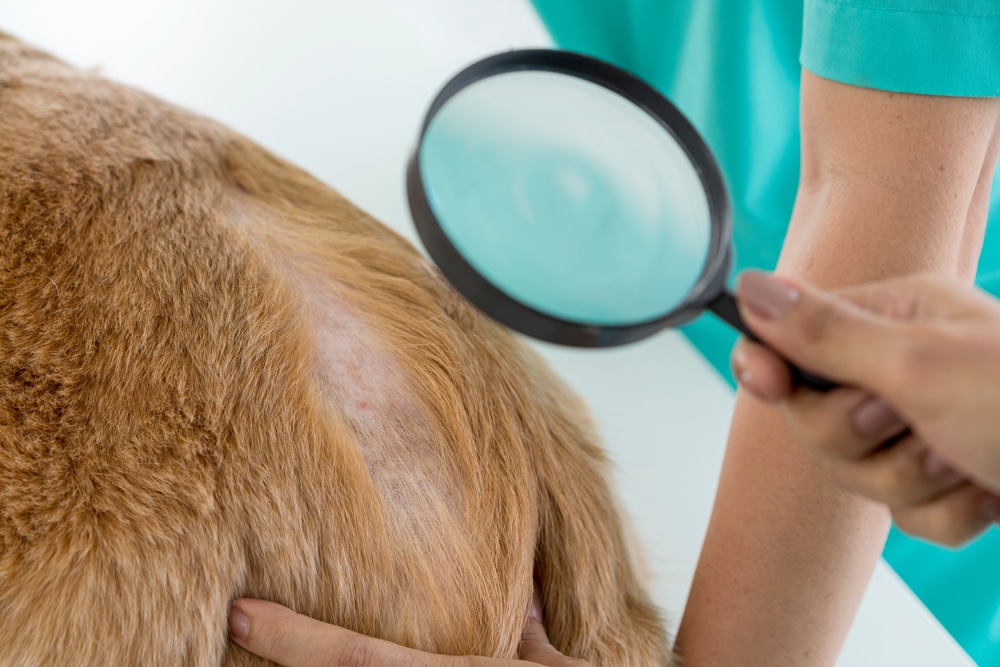
Additionally, ringworm are commonly found on the face, ears, tail and paws.
How does my dog catch ringworm?
Transmission can happen by direct contact with another infected animal or person. It can be passed between dogs and cats. And from pets to humans and vice versa.
The fungal spores can live in the environment for a long time. And they can be found in carpets, bedding, grooming equipment. They can infect your dog when it comes into contact with them.
The incubation period is 10-12 days. This means that following exposure to the fungus, about 10-12 days will pass before any lesions occur.
In rare cases, ringworm can be spread by contact with infected soil. The fungus can live for months in soil if the nutrients are right.
Fortunately, the spores are easily killed with a solution of 500 mLs of bleach and 4 liters of water.
Can humans catch ringworm from dogs?
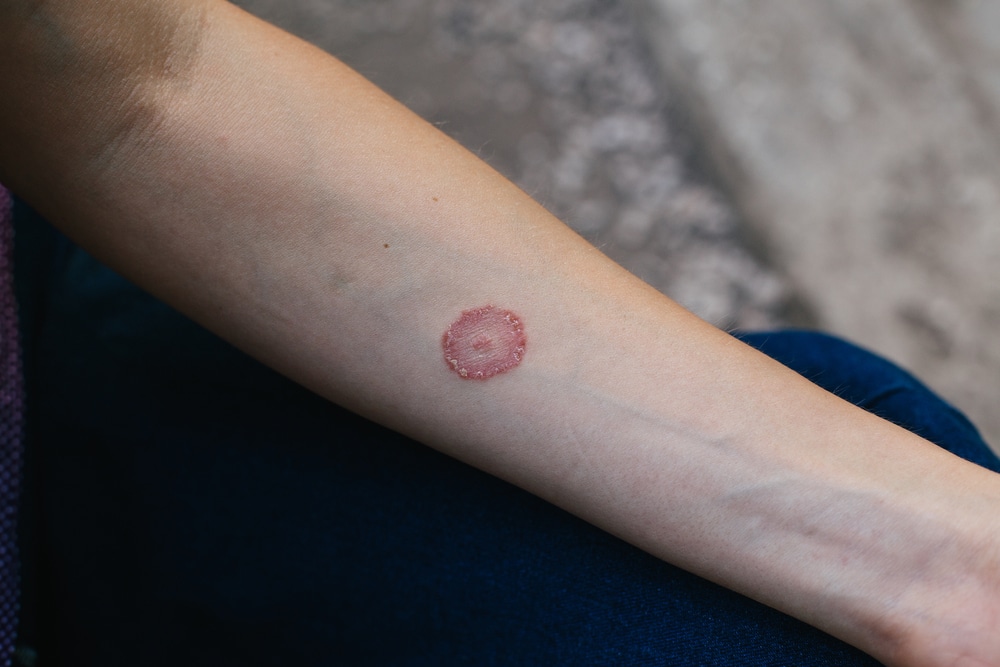
Ringworm is contagious and can be spread from a dog or cat to a human. Humans can catch ringworm by touching an infected dog or cat with ringworm. It is then transmitted by direct contact with an infected cat or dog’s skin or hair.
In addition to that, children are more likely to become infected by ringworm from cats and dogs than adults.
Are all dogs susceptible to ringworm?
Healthy adult dogs usually have a resistance to ringworm. However, puppies are more susceptible because their immune system hasn’t fully developed.
Many dogs are carriers of ringworm but show no symptoms. They can, however, still infect other animals or humans.
Diagnosis of ringworm in dogs

Diagnosing ringworm in dogs is not possible by just looking at the skin. Your vet will need to do one of the following tests:
- Wood’s Lamp. This is an ultra violet lamp also known as a black light. Your vet may use this as 50% of microsporum canis will glow under the lamp.
- Microscopic diagnosis. Your vet may look at the part of the hair or skin from the lesion under a microscope.
- Culture. Your vet may decide to take a scraping from the lesion and send it to the laboratory to see what the culture grows.
Treatment of ringworm in dogs
If no treatment is carried out, ringworm will run its course in two to four months. And the symptoms will resolve themselves.
However, treatment is recommended to save your dog from suffering any longer. And to help cut down the period of time they are contagious.
1. Banixx
Banixx is an effective ringworm treatment for dogs and cats. The reason for Banixx’s success on ringworm in dogs is because it’s a potent anti-fungal treatment. It can kill 99% of most fungal spores within minutes.
Moreover, it has no burn or odor to create fear in your pet,. And is totally safe around the eye, making application easier still.
2. Griseofulvin
Your vet may prescribe Griseofulvin (tablet or capsule) for your dog. It is an anti-fungal drug that is used for dogs with ringworm. It inhibits fungal reproduction but it does have some side effects.
3. Shampoos and dips
Lime sulfur dips are sometimes recommended. And should be given twice a week and can be performed either by your vet or at home.
Please be aware that lime sulfur will stain clothing and jewelry. It will also cause temporary yellowing of the dogs hair. Furthermore, it smells very strongly of rotten eggs. So make sure to follow your vet’s instructions for mixing the dip.
4. Decontamination
Use bleach mixed at 1:10 on any surface that you can. It will kill 80% of the spores. Vacuum on a daily basis and dispose of vacuum bags which will contain the spores.
Steam cleaning of carpets and furnishings will also kill a large number of the spores.
Don’t forget your dog’s bedding and kennel. Wash the kennel down with a bleach solution. And wash the bedding in very hot water.
Furthermore, if your dog is an inside dog, confine him to one room of the house.
Conclusion
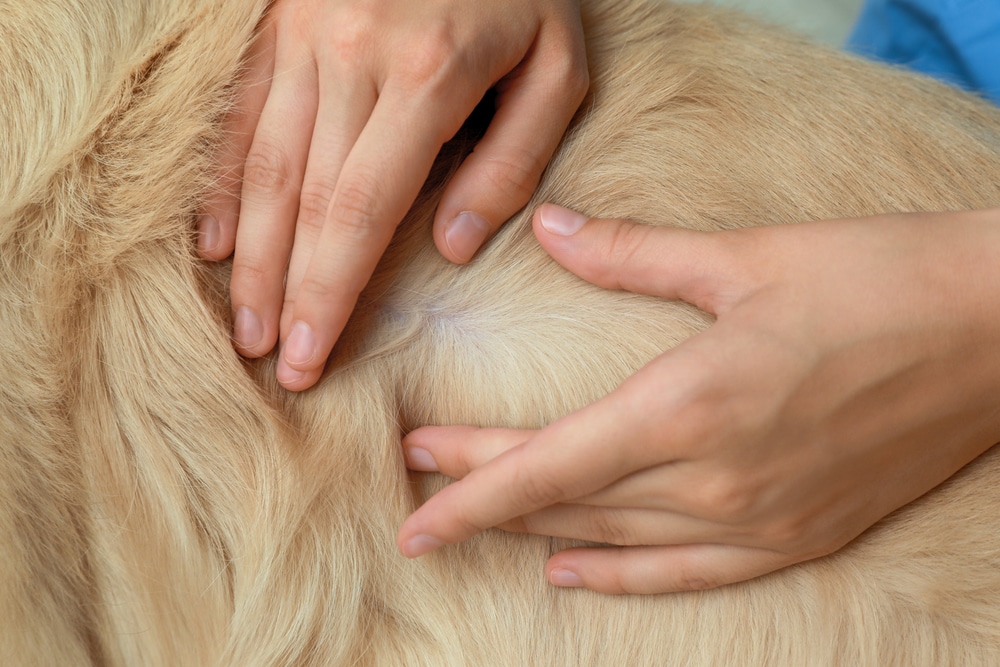
Being well informed about ringworm in dogs is important. Because knowing the symptoms and treatments will help you act fast. This will help keep your dog’s skin clean. And prevent the spread of ringworm not only for your dogs, but to other people or pets.