|
 |
Learning Primer
Teaching Basic Behaviors
by Jackie Nelson
|
Teach your Dog - Sit - Down - Come
In this article you will gain an understanding
of how your dog learns and how to teach basic behaviors such as sit,
down, and come.
Teaching our dogs basic behaviors is essential to
having a happy relationship with our pets. Instead of titling this
article “Teaching Basic Behaviors”, I chose to call it a “Learning
Primer.” It is essential to understand how our dogs learn in order to
teach them successfully. With this knowledge can we be truly effective
leaders. This article will not only help you train the basic behaviors
discussed later, but it will give you tools to teach a variety of
behaviors and troubleshoot future training sessions.
Part I – Why did he do that?
A dog’s
world is based on the consequences of his
actions
Fido drops the ball at your feet. You throw it. Fido
drops the ball at your feet. You throw it. Sound familiar? Did you ever
wonder why your dog does this or how they learned? A dog’s world is
based on the consequences of his/her actions and the consequences
of other activities the dog observes. What is the consequence of Fido
dropping the ball at your feet? You throw it. What is the consequence of
Fido dropping the ball next to a tree? The ball sits next to the tree.
Which behavior is more likely to recur? The behavior that brought a
positively valued consequence to the dog is more likely to recur.
You have to get the timing right - Using a
Clicker
Timing is another
essential part of how a dog learns. If Fido drops the ball and you throw
it an hour later, is he likely to repeat this behavior? Nope. The
consequence must be immediate to the behavior, ideally within a few
seconds. Since this close timing can be difficult for us to deliver (can
you get a treat in your dog’s mouth within a second of their rear
hitting the ground when asked to sit?), we use a tool called a bridge
to address the gap between behavior and reward. The most common example
a bridge is a clicker. A clicker is a small box that makes a distinctive
click sound when a button is pressed. Now as the dog’s rear hits the
ground we click at the exact moment. Then we deliver the treat. Our
treat can take an additional four to five seconds and the dog still
understands the piece of the behavior we wanted and are rewarding. We
provide a positive consequence in a timely manner and create a drive for
the dog to repeat the behavior. Another common marker is using a short,
sharp verbal such as “yes”.
Rewards
All rewards are not created equally. The example with
the ball above only works if the dog feels chasing and retrieving the
ball is a reward. It is important in training to look for rewards the
dog finds valuable, not what we think should be valuable. Before I start
training, I make a list for my dog. I list treats, games, and toys from
the lowest value (dog cares only a little about them) to the highest
value (dog is bouncing off the ceiling for it). For most training with
minimal distractions a moderate or low-moderate reward is adequate. Some
dogs have very little interest in the training game and require a high
value reward always. Work off your dog’s list and adjust reward values
as necessary.
Part II – How do we get the dog to do
that?
Manipulating the consequence of a behavior influences
the likelihood of the behavior to repeat or stop. But how do we get our
dogs to do the desired behavior in the first place? In Part II we will
discuss the difference between a reward and a bribe,
luring behaviors, capturing behaviors, free shaping
behaviors, and physical placement.
What's the difference between a Reward and
Bribe?
A reward always follows a behavior. It occurs
after the behavior. A bribe is displayed to the dog prior to the
behavior. The bribe says “Hey look what I have! If you sit when I ask
I’ll give it to you!” The bribe becomes a pre-emptor of the behavior;
that is the bribe becomes more important than the behavior to the dog.
The dog always expects the bribe to be there before doing the behavior.
This is a common problem when a person trains their dog with food and
has a dog that only works when shown the food. When using food or toys
as a reward in training, I find it handy to keep them in a back pocket
or on a countertop nearby. I will leave some training treats out so my
dog never knows if they might get one this time. For example, my dog has
learned to sit. I ask for a sit at the front door before we go out.
Every time the sit earns an open door. Occasionally the sit is followed
by a treat kept handy by the front door. The reward always follows the
behavior.
Teaching your dog to sit with the Lure
Method
There are several ways to teach a behavior. The first
we will discuss is the lure method. A lure is something the dog
follows (a treat in the hand) to manipulate their body into the desired
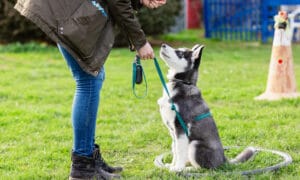
behavior without physically touching the dog. For example, to teach sit
with the lure you hold the food in your hand between your fingers. Allow
the dog to sniff the food but don’t let him snatch it. Lure the dog’s
nose back over its head keeping at the height of the nose. Most dogs
will sit their rear down in order to follow the lure. When the rear hits
the ground, we can use the clicker or voice to mark the behavior (I use
a sharp “yes” as a voice marker) and feed the treat. Once the dog does
this a few times, remove the food from your hand. Lure with a blank hand
and click and treat. Once you add a word to the behavior (first saying
it while the dog is in the process of sitting and slowly earlier until
the cue comes before the behavior), make your luring motion smaller and
smaller until it is a minor hand signal or completely gone (this is your
preference whether you wish to use a hand signal, verbal cue, or both –
I usually use both).
Teaching your dog 'Down' with the lure
method
Another example of luring is used to teach the down
command. Most dogs will lie down if you lure their nose down between
their front feet and back towards their chest. If you have a dog that
puts their front end down but not their rear, you may have luck using a
lure with the tunnel method. For this, you sit on the floor. Make a
tunnel out of one of your legs. Your tunnel should be low enough so your
dog will have to put his rear on the ground to make it through. Using
the hand lure, ask your dog to put their head in the tunnel. Reward for
this a couple of times. Then ask for up to their shoulder. Slowly ask
for more and more until the dog’s whole body is under your leg and they
are lying down. For dogs that are hesitant, take your time. You may need
a few sessions to get them comfortable putting the first half of their
body through. Don’t rush and have patience. It may take longer to go
through the baby steps, but your dog will gain confidence and trust in
your relationship through the process.
The Capture Method
The next method for teaching a behavior is called
capturing. The idea behind capturing is not to give the dog any
help. To capture a sit, you simply wait for your dog to sit. A good way
to do this is keep an eye on your dog while you watch a television show.
Each time the dog sits, click and treat! After a few times your clever
canine will try to get you to click and treat. Your dog will start
offering the sit! Once the dog is readily offering the sit, you can add
your cue word/hand signal during the sit, slowly working until you give
the cue before the sit. Capturing is a great method for dogs who do not
follow a lure well or who are afraid of the close contact of luring.
This is also a great way to teach your dog that they never know when
something good might happen, so check in with mom and dad! They may get
a reward for lying down while you watch television or cook dinner. It
might be worth it to the dog to try these behaviors more often! Once a
behavior is on cue, I will still give random praise rewards. For
example, my dog lies quietly with a bone. I say “Good down! Good dog!”
These random rewards increase a dog’s desire to do a behavior for you.
They never know when a great thing may come so it is worth trying!
Free shaping or shaping a
behavior means building a behavior on tiny increments. For example,
shaping a dog to walk around a traffic cone would go something like
this:
Click and treat for looking at the cone
Click and treat for stepping towards the cone
Click and treat for nosing the cone
Click and treat for taking one step around the
cone
Click and treat for getting one quarter of the
way around the cone
Click and treat for getting half way around
the cone
Click and treat for getting three quarters
around the cone
Click and treat for getting all the way around
Click and treat for walking away from handler
one step toward the cone
-20. Click and treat each step until the dog
walks to the cone and around it
Free shaping implies the dog does not have guidance
from the handler. The handler places the cone and does not say or do
anything to encourage a behavior. This is a fun brain game for dogs.
Often in shaping the handler will give a “hint” in a gesture, verbal
encourage, or lure to get things started or help the dog over a hump.
The last method we will discuss is physical
placement.
This means the handler places their hands on the dog and
physically forces the dog into the desired position. While some dogs
understand this, it has drawbacks. Some dogs are frightened or hesitant
with this method, making them associate negative feelings with the behavior. When a dog places themselves in a position it creates
something called muscle memory. This is the same reason you can hop on a
bicycle after years of not riding and your body remembers how to balance
and pedal. When you consciously make a movement time after time, your
nerves and muscles remember what it feels like. For a dog who has sat on
cue a hundred times, their body can begin to automatically sit upon
hearing or seeing the cue. Muscle memory is only created when the dog
voluntarily moves. Placing the dog does not create muscle memory because
the dog will either give resistance or go lax, neither of which resemble
the muscle memory of performing the behavior. For these reasons,
physical positioning is not the first choice for teaching a new behavior.
Be aware of the potential negatives of using this as your primary
training method.
Part III – Conclusion
You have learned why dogs do things and how to teach
new behaviors. For the conclusion, we will talk about some common
behaviors and instructions for my favorite method to teach them.
Remember you have a basic knowledge of a number of methods for teaching.
Do not hesitate to try one of them if you or your dog has trouble with
those below. We have already addressed sit. We will work on down, come,
stay, and paw touching for nail trimming.
One final training note: Dogs do not generalize
behaviors. This means what you teach in your living room does not apply
outside in the yard. Once you have a behavior on cue, start working it
in a variety of locations. Go from locations with low levels of
distraction to locations with higher levels. So, for example, I teach
sit in the family room, kitchen, deck, back yard, and front yard. Then
we do it on a walk, at the park, at a busy park, at the lake, at the pet
store. You may need to take a few steps back as you move to places of
higher difficulty. That is normal. A few lures to remind the dog usually
gets things going. Another thing that may help is using a higher value
reward as the difficulty increases. A piece of dry kibble or plain toy
at home would be a piece of hot dog, cheese, or favorite squeak toy at
the park. If you do this hard work from the beginning, each new behavior
will be easier and easier to generalize to more distracting
environments.
Down Please refer to part
two for luring the down. I like to capture the lay down behavior. Dogs
readily do this all day long. If you keep a clicker and a few treats in
your pocket and pay attention to your dog, you will be able to
click/treat numerous downs for a few days. Once your dog has a history
of being rewarded for this behavior, begin saying your cue while the dog
lies down. Slowly say the cue earlier and earlier until your dog is
laying down on cue. Generalize the behavior.
Come The come or
recall behavior means your dog comes to you when called or signaled.
A verbal cue is usually helpful for calling a dog that is not looking at
you. I always teach both a hand and voice cue for this behavior. It is
important to remember no matter how unhappy with your dog you may be
with your dog, calling your dog should always be a happy experience for
the dog. Even if your dog tore the leash out of your hand and ran off,
you need to put on your happy face when he comes when called.
I like to do a few things when teaching the recall.
The first is restrained recalls. This takes 2 people and some tasty
treats or fun tug toys. One person holds onto the dog (a leash tab
attached to a harness or collar can be helpful). The other person
becomes very animated and excited and calls the dog. Dog is released and
has a praise party with reward when they get to the other person. Send
the dog back and forth. Five or six repetitions twice a day will be a
lot of fun for your dog and build a great, positive feeling about coming
when called.
The second game is “fishing” recalls. You “throw” your
dog out and use your recall to “reel” them back in. Get a long line
(20-30 feet long). In the house, attach it to the dog’s collar or
harness. Toss a treat or toy for the dog. Once the dog gets it, call the
dog excitedly as you back up or turn and run. When the dog gets to you
reward and play. Toss the treat or toy for the dog and repeat. Limit
your session to only a few repetitions. Once the dog is doing this well
in the house, take it outside. The long line should be a security
measure, not for physically reeling in the dog. Practice in your yard.
Here you can throw the treat or toy or just let your dog to wander and
sniff on their own. Once your dog is consistent in this environment, go
to more distracting places. Always utilize your long line for safety.
After your dog comes to you and is rewarded, always let them return to
what they were doing. Your recall should never be the ultimate end of a
game. Do not use your recall to bring your dog inside from play or
punish your dog. The recall is ALWAYS fun. You can use a different cue
to bring your dog inside or out of the park.
Once your dog is a pro with distractions, find safe
places to practice off leash. These could be a training building, fenced
yard, fenced park, friend’s home, etc. Always be sure your dog is safe
if for some reason they were to run off. As you increase the difficulty,
do not hesitate to go back to your crazy excitement and running away to
get your dog excited! Excitement and fun are what we want the dog to
remember about the recall games.
When using the clicker for the recall, initially click
when the dog makes eye contact and you can see the intent to run to you.
Slowly click later until you are clicking when the dog get to you. The
clicker is always a powerful tool for training and learning new
behaviors!
Stay The stay behavior
has two components – duration and distance. It is important to train one
at a time. I start with duration or the length of time the dog maintains
the position (or location if you do not want to be specific about
position). I ask the dog to sit or down and give my stay cue. I then
maintain standing right next to the dog for my time period. At the end I
reward my dog in that position and release them. For example, “Fido sit.
Stay.” Wait three seconds. Treat, “ok, good dog!” For some dogs
it may start with a second or two. Build the time up slowly. The goal is
for the dog to be successful. Once you get up to ten second, vary the
time. Do a stay for two seconds, then ten, then five, then eleven. This
prevents the dog from anticipating when it will be released. I work up
to a minute in one position and then start over with another position.
Once they are both up to a minute I start over alternating positions
until I can do several minutes each. It is easier for a dog to lie down
for a longer period, so eventually I only ask for a down for five
minutes or longer. It is important to be fair to the dog.
Once I have hit a minute consistently with multiple
positions I add in distance. I start by stepping in front of the dog
from my original position at the side. I immediately step right back and
reward/release. I build up time to about twenty seconds in this
position. Then I add a step away both straight forward from the side
position and a step back from being in front of the dog. I slowly build
up more distance along with the time.
If the dog gets up during any of the training, body
block the dog (using your body walk into the dog to push them back) to
the place, gently reset them how they should have been, and repeat the
stay cue only. The dog did not break the sit or the down; the dog broke
the stay. Do not repeat the sit or the down, only the stay. I would also
back up a step in the training (so reduce duration or distance) so the
dog can succeed. Keep your sessions short – just a minute at first. As
your work up the duration you can increase the session time to a few
minutes. In order to always end on a positive note, stop while you are
ahead. We want our training session to end with a reward for success.
Set a timer to limit yourself if needed. This will help prevent you or
your dog from becoming frustrated.
Don’t forget to visit the
Dog Chat message boards for
any questions about this or other articles on Dog Chat.
Author: Jackie Nelson |